Codaryn
Delta Pathway
Delta Pathway
- 📁 Digital file available after purchase
- 🗂️ Long-term availability
- 🔒 Secure checkout
- 📝 Content updated in 2026
Couldn't load pickup availability
Self-paced learning overview
Problem Statement
After working with basic and middle-stage topics, learners often begin to see that knowing syntax separately is no longer enough. A learner may understand conditions, loops, lists, and functions on their own, but difficulty appears when these parts need to be combined into one connected task. Code may have several stages: preparing data, checking values, repeating actions, processing a result, and showing a summary. If the connection between these parts is unclear, the example may look longer and harder to read. Delta Pathway was created to help learners notice transitions between code sections and understand how one action leads to the next.
Solution
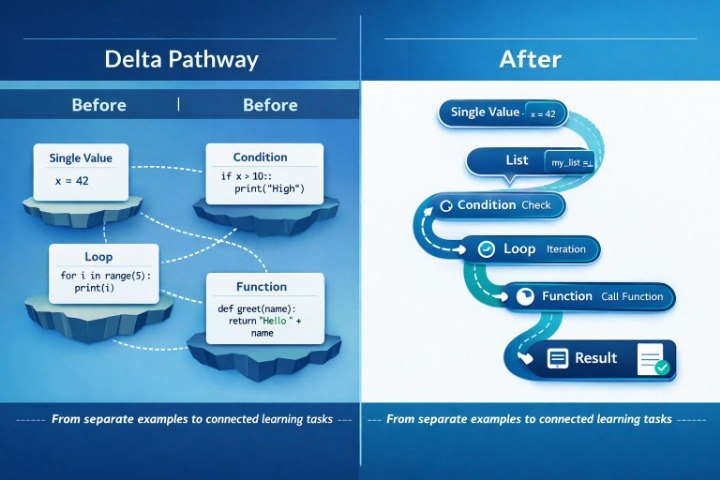
Delta Pathway presents Python programming through learning transitions. Learners see how a small example gradually expands: first it works with one value, then with a list, then with a loop, a condition, a function, and a final result. The materials explain not only the finished code version, but also the building process: what was added, why the structure changed, which part handles the check, and which part handles processing. This approach helps learners read code as a sequence of decisions rather than as a random group of lines. Delta Pathway fits well after Spark Deck, when the learner already has compact review cards and is ready to work with longer learning connections.
What’s Inside
Delta Pathway includes learning materials built around the idea of moving from a short example to a more connected task. The first module is called “From Single Value to Flow”. In it, learners see how a simple action with one value gradually turns into logic with several steps. For example, the code first checks one number, then adds a text explanation of the result, then introduces a function, and then expands into work with a list of values.
The second module focuses on building a learning route through conditions. Learners study examples where the decision depends not on one check, but on several connected conditions. The materials explain how to read these examples from top to bottom, how to see the main check, how to find additional decision branches, and how to describe the result without confusion. Some tasks invite learners to change the order of conditions and compare how it affects code behavior.
The third module focuses on loops in longer examples. Here, learners see how a loop can do more than repeat an action: it can be part of a larger process, move through a list, check each element, store an intermediate result, and create a final summary. The materials explain what happens before the loop, what changes inside it, and what value remains after repetition ends.
The fourth module is about functions as a way to collect logic into a separate block. In Delta Pathway, a function is not viewed in isolation but as part of a learning route. Learners see how a function can receive a list, make a check, use a loop, and return a final value. The explanations show where the function logic starts, which data it receives, which intermediate actions it performs, and what it returns at the end.
The fifth module is called “Delta Changes”. It focuses on changes in code. Learners receive one example in several versions: an initial version, an expanded version, a version with a function, and a version with an additional check. The task is to describe what changed between versions. This helps learners see how code develops and avoid getting lost when an example becomes longer.
The sixth module focuses on simple learning scenarios. These are tasks where several parts of Python programming need to be combined: create a list, move through it with a loop, check a value, store a result, and return it through a function. The scenarios remain educational but give learners more context than a separate example. Each scenario includes a breakdown by parts: input data, main logic, checks, repetition, and result.
A separate Delta Pathway block is dedicated to reading longer examples. Learners practice dividing code into logical sections: preparation, processing, checking, repetition, and result return. In the tasks, the goal is not only to get an answer, but also to explain the role of each section. This format helps learners read examples where several topics work together.
The tier also includes a “Path Notes” block. These learning notes help learners follow transitions between topics. They collect short explanations: how to understand that a task needs a list, when a loop fits the task, why a function can make the structure more readable, how to check an intermediate result, and how to describe the final result in personal wording.
Delta Pathway also includes comparison tasks. In them, learners see two or three versions of one learning scenario. One version may be shorter, another more expanded, and a third divided into functions. The task is to compare not only the result but also the structure: where the input data is clearer, where the check is easier to follow, and where value changes are simpler to trace.
Another part of the tier is code completion practice. Learners receive an incomplete example and add a missing part: a condition, loop, function, empty-list check, or result return. After that, a breakdown explains why that part is needed and how it affects the full logic of the example.
Who Is This For?
Delta Pathway is suitable for learners who have already worked with conditions, loops, lists, functions, and short practical tasks, but want to see the connections between them more clearly. It is a good option for those who understand separate parts of Python programming but want to read longer examples as a connected system.
This tier is also useful for learners who want to explain task logic in their own words more steadily. If a longer example makes it difficult to see where the main action begins, where the result is formed, and what role each part has, Delta Pathway helps divide the material into clear learning transitions. It fits learners who value structured scenarios, comparison of code versions, and careful breakdowns.
What You’ll Learn
- How to move from a short example to a connected task.
- How to combine conditions, lists, loops, and functions.
- How to read longer code through logical sections.
- How to see what changed between versions of one example.
- How to describe the role of each code part.
- How to work with learning scenarios.
- How to check intermediate values during execution.
- How to compare different structures with the same result.
- How to complete an unfinished example with a needed part.
- How to use notes to review transitions between topics.
30-Day Refund Policy
Delta Pathway includes a 30-day refund policy. If, after purchase, the learner sees that the format of the materials does not fit their needs, they can contact the Codaryn team within 30 days. The request is reviewed according to the refund terms described on the site. This section is presented as calm purchase information without pressure or exaggerated claims.
How is learning organized in Codaryn?
How is learning organized in Codaryn?
Learning is divided into topics, blocks, and practical examples. This format helps learners study Python programming through an organized path: concept, example, task, and review.
Can a paid order be refunded if the course does not fit my needs?
Can a paid order be refunded if the course does not fit my needs?
Yes, paid tiers include a 30-day refund policy. If the materials do not match the learner’s expectations, they can contact the Codaryn team within 30 days after purchase, and the request will be reviewed according to the refund terms.
What is included in Codaryn tiers?
What is included in Codaryn tiers?
Depending on the tier, learners receive learning modules, practical tasks, code examples, term explanations, short topic summaries, and additional resources for review. The tiers are arranged in a growing order, with each following tier offering a wider set of materials.
Are Codaryn courses suitable for starting Python programming?
Are Codaryn courses suitable for starting Python programming?
Yes, Codaryn materials are organized to help learners gradually explore Python programming topics. Each tier has its own depth, from introductory explanations to wider collections with tasks, examples, and learning resources.
Share