Codaryn
Echo Bundle
Echo Bundle
- 📁 Digital file available after purchase
- 🗂️ Long-term availability
- 🔒 Secure checkout
- 📝 Content updated in 2026
Couldn't load pickup availability
Self-paced learning overview
Problem Statement
After the first steps in Python programming, learners often notice that familiar concepts fade if they do not return to them through different tasks. Conditions, loops, lists, and functions may feel clear while reading, but more challenging during independent work. A learner may understand an example in the materials, yet feel unsure when writing similar code from the first line. Without review in different formats, knowledge can remain as separate fragments that are difficult to connect into one learning approach. Echo Bundle was created to help learners revisit key topics more often and see them in different learning situations.
Solution
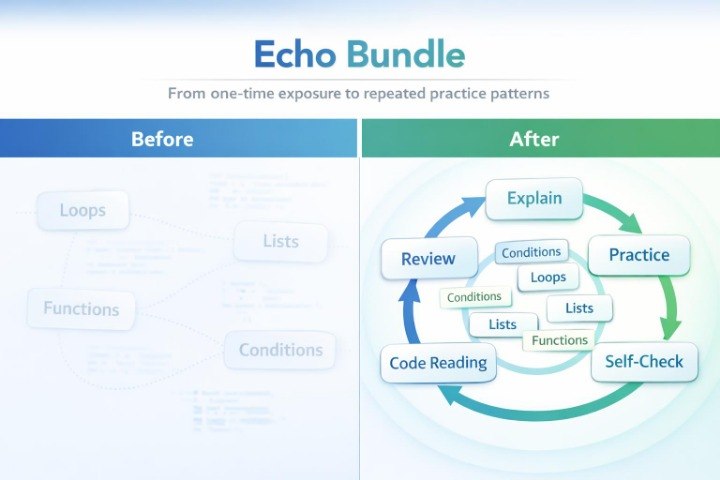
Echo Bundle builds learning around review, practice, and careful code reading. Each topic appears more than once and in several formats: explanation, example, task, breakdown, short summary, and self-check question. This approach helps learners see how the same idea works in different parts of Python programming. The tier focuses on connections between topics, so learners do not only move from block to block but also notice how previous concepts return in new examples. Echo Bundle works well after Layer Set, when the learner already has a basic structure but needs wider practice.
What’s Inside
Echo Bundle includes learning materials built around returning to core Python programming topics through different formats. The first block revisits variables, data types, and basic operations. Instead of giving learners a plain list of concepts, this block includes examples where these topics appear in different contexts: text processing, working with numbers, comparing values, storing an intermediate result, and reading output.
The second block focuses on conditional logic. Learners study several types of checks: simple conditions, nested conditions, multiple decision branches, and cases where the result depends on a combination of values. Each example includes an explanation that breaks the code into separate parts: what is being checked, why that condition is used, what result is created, and how the behavior changes when the input value changes.
The third block is dedicated to loops. Here, learners see how repeated actions work with lists, text values, and simple counts. The materials explain the order of execution, the role of a variable inside a loop, and common situations where a loop ends differently than expected. Some examples are built so learners can describe each execution step in their own words.
The fourth block explores lists and basic work with groups of data. Learners practice reading a list, adding elements, changing values, going through elements with a loop, and creating simple results based on a list. This block gives special attention to indexes, list length, and understanding which element is being used at a specific moment.
The fifth block focuses on functions. The materials explain how a function helps move part of the logic into a separate block, how values are passed, how a result is formed, and why a function name should describe its action. Learners see examples of simple functions for calculations, text work, value checks, and reuse of small code fragments.
A separate part of Echo Bundle is the “Echo Practice” block. It is a series of tasks where topics intentionally return in a changed form. For example, a learner first works with a condition, then sees the same logic inside a loop, and later inside a function. This format helps learners notice familiar elements even when the task looks different.
The tier also includes breakdowns of common mistakes. They are not presented as a dry list; instead, they explain why the mistake appeared, how to read it, which line deserves attention, and how to check a personal assumption. These may include a variable name issue, a wrong data type, an incorrect condition, an extra indentation, or a return statement placed in the wrong part of a function.
Echo Bundle includes short summaries after each group of topics. These summaries collect key ideas, review questions, and small self-check tasks. For example: “What changes if the list is empty?”, “Which condition runs first?”, “What does the function return?”, “Which value changes after the loop pass?”.
Another part of the tier is a set of learning notes for code reading. They help learners look at an example not as a random group of lines, but as a sequence of actions. The notes explain how to find the main idea of an example, how to divide code into parts, how to trace changing values, and how to describe the result without copying someone else’s explanation.
Echo Bundle also prepares learners for the next tiers in the Codaryn line. It does not try to cover every topic at once; instead, it focuses on returning to basic and intermediate ideas that often become the base for wider learning blocks. Through this, learners receive more practical contact with code and better understand how familiar topics return in new tasks.
Who Is This For?
Echo Bundle is suitable for learners who have already completed introductory materials or have basic familiarity with Python programming, but want more review and practice. It is a good option for those who understand examples while reading but want to work with similar tasks more steadily on their own.
This tier is also useful for learners who need to see one topic in different formats. If concepts are easier to remember through repetition, comparison, and repeated use, Echo Bundle provides that learning rhythm. It fits learners who want to read code more carefully, examine mistakes, explain examples in their own words, and gradually move toward larger tasks.
What You’ll Learn
- How to review basic Python programming topics through different examples.
- How to read code in order and identify the role of each block.
- How conditions work in simple and expanded examples.
- How to use loops for repeated actions.
- How to work with lists and individual elements.
- How to create simple functions with parameters and a result.
- How to notice familiar topics in new tasks.
- How to analyze common code mistakes.
- How to describe program execution in your own words.
- How to use summaries and questions for review.
30-Day Refund Policy
Echo Bundle includes a 30-day refund policy. If, after purchase, the learner sees that the format of the materials does not match their expectations, they can contact the Codaryn team within 30 days. The request is reviewed according to the refund terms described on the site. This section is presented as transparent purchase information, without exaggerated claims or extra pressure.
How is learning organized in Codaryn?
How is learning organized in Codaryn?
Learning is divided into topics, blocks, and practical examples. This format helps learners study Python programming through an organized path: concept, example, task, and review.
Can a paid order be refunded if the course does not fit my needs?
Can a paid order be refunded if the course does not fit my needs?
Yes, paid tiers include a 30-day refund policy. If the materials do not match the learner’s expectations, they can contact the Codaryn team within 30 days after purchase, and the request will be reviewed according to the refund terms.
What is included in Codaryn tiers?
What is included in Codaryn tiers?
Depending on the tier, learners receive learning modules, practical tasks, code examples, term explanations, short topic summaries, and additional resources for review. The tiers are arranged in a growing order, with each following tier offering a wider set of materials.
Are Codaryn courses suitable for starting Python programming?
Are Codaryn courses suitable for starting Python programming?
Yes, Codaryn materials are organized to help learners gradually explore Python programming topics. Each tier has its own depth, from introductory explanations to wider collections with tasks, examples, and learning resources.
Share