Codaryn
Edge Module
Edge Module
- 📁 Digital file available after purchase
- 🗂️ Long-term availability
- 🔒 Secure checkout
- 📝 Content updated in 2026
Couldn't load pickup availability
Self-paced learning overview
Problem Statement
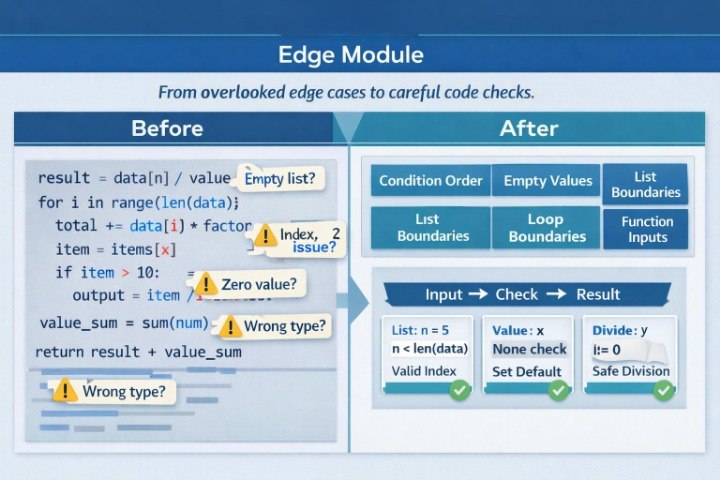
After studying basic topics, learners often begin writing longer examples, and this is where more detailed issues appear. Code may look correct at first, but return a different result because of one condition, an extra indentation, or a value that was not considered. Difficulties often appear at the edges of a task: what happens if a list is empty, a number is zero, text has another format, or a function receives an unexpected value. These situations should be studied not by chance, but as a separate part of learning. Edge Module was created to help learners notice these boundary cases and better understand how they influence code execution.
Solution
Edge Module presents Python programming through details that are often missed in the early stages. Learners explore examples where a small change in a condition, list, loop, or function changes the result of execution. The materials help learners examine code carefully: what exactly is being checked, which value is passed, where a block starts and ends, and what happens with empty or unusual values. The tier focuses on practical situations where the learner needs not only to write code, but also to check its behavior in several variants. Edge Module fits well after Mode Guide, when the learner can already read execution modes and wants to work more carefully with details.
What’s Inside
Edge Module includes learning materials focused on boundary situations in Python programming. The first module is about conditions and the order of checks. Learners study examples where several conditions may influence each other and the result depends on which check comes first. The materials explain how to read these structures in order, how to notice extra or incomplete checks, and how to describe the logic of a decision in personal wording.
The second module focuses on empty values and missing elements. In this block, learners see examples with empty lists, empty text, zero values, and situations where an expected element is not found. The materials explain why these cases should be checked separately, how they can change loop or condition behavior, and how to read the result without rushed conclusions.
The third module explores lists and index boundaries. Learners practice working with the first and last element, checking list length, understanding index-related errors, and seeing the difference between an element’s position and its value. This block includes examples where code works with a short list, a longer list, and a list with no elements, so learners can compare behavior across different cases.
The fourth module is dedicated to loops and repetition boundaries. It includes examples where a loop runs a certain number of times, does not run at all, or ends in a different place than expected. The materials explain how to follow a variable inside a loop, how to understand the continuation condition, how to notice extra repetitions, and how to check the result after the loop ends.
The fifth module focuses on functions and input values. Learners see how a function behaves with different data types, empty values, short lists, text, and numbers. The explanations show why it matters to understand which values a function receives, what it does with them, and what result it returns. Examples with several decision branches inside a function are also included.
The sixth module focuses on reading errors and finding their cause. The materials do not suggest guessing the issue; they show an organized way to examine it: read the message, find the line, check the value, look at the data type, review indentation, and examine condition logic. Learners work with examples of errors in variables, lists, conditions, loops, and functions.
A separate Edge Module block is called “Boundary Practice”. It includes tasks where learners need to check code in several variants. For example, a learner receives a function that works with a list and needs to describe what happens with a list of three elements, one element, and no elements. Or they receive a condition that checks a number and need to explain how it behaves for a positive, negative, and zero value.
The tier also includes learning tables for comparison. In these tables, learners can see the same logic with different input values and different results. This format helps learners look beyond a single example and ask wider questions: “What changes if the value is different?”, “Will the condition run?”, “How many times does the loop run?”, “What does the function return?”.
Edge Module also includes summary notes after each module. They collect important ideas, common mistakes, short examples, and self-check questions. These notes help learners return to a topic during review and better notice which details deserve attention.
Who Is This For?
Edge Module is suitable for learners who are already familiar with conditions, loops, lists, and functions, but want to work more carefully with code details. It is a good option for those who sometimes understand the general idea but get lost in specific cases where the result changes.
This tier is also useful for learners who want to better understand errors, check code in different situations, and explain program behavior not only for one example but for several variants. Edge Module fits those who value practical breakdowns, learning tables, comparison tasks, and careful attention to boundary cases.
What You’ll Learn
- How to analyze boundary cases in Python programming.
- How condition order can change the result.
- How to work with empty lists and empty text.
- How to check the first, last, and missing list element.
- How to read index-related errors.
- How to trace loop execution boundaries.
- How a function behaves with different input values.
- How to compare results across several data variants.
- How to find the cause of an error through organized review.
- How to use notes and tables for review.
30-Day Refund Policy
Edge Module includes a 30-day refund policy. If, after purchase, the learner sees that the format of the materials does not fit their needs, they can contact the Codaryn team within 30 days. The request is reviewed according to the refund terms described on the site. This section is presented as calm purchase information without pressure or loud claims.
How is learning organized in Codaryn?
How is learning organized in Codaryn?
Learning is divided into topics, blocks, and practical examples. This format helps learners study Python programming through an organized path: concept, example, task, and review.
Can a paid order be refunded if the course does not fit my needs?
Can a paid order be refunded if the course does not fit my needs?
Yes, paid tiers include a 30-day refund policy. If the materials do not match the learner’s expectations, they can contact the Codaryn team within 30 days after purchase, and the request will be reviewed according to the refund terms.
What is included in Codaryn tiers?
What is included in Codaryn tiers?
Depending on the tier, learners receive learning modules, practical tasks, code examples, term explanations, short topic summaries, and additional resources for review. The tiers are arranged in a growing order, with each following tier offering a wider set of materials.
Are Codaryn courses suitable for starting Python programming?
Are Codaryn courses suitable for starting Python programming?
Yes, Codaryn materials are organized to help learners gradually explore Python programming topics. Each tier has its own depth, from introductory explanations to wider collections with tasks, examples, and learning resources.
Share