Codaryn
Layer Set
Layer Set
- 📁 Digital file available after purchase
- 🗂️ Long-term availability
- 🔒 Secure checkout
- 📝 Content updated in 2026
Couldn't load pickup availability
Self-paced learning overview
Problem Statement
After the first introduction to Python programming, many learners need more than a basic review; they need to see how the topics work together. Variables, conditions, data types, and simple functions may feel clear separately, but difficulty appears when they need to be combined in one example. A learner may look at a code fragment and not immediately understand the role of each line. Because of this, studying can feel uneven: one topic seems familiar, while the next one creates confusion. Layer Set was created to add more order between basic topics and show how they connect into one code structure.
Solution
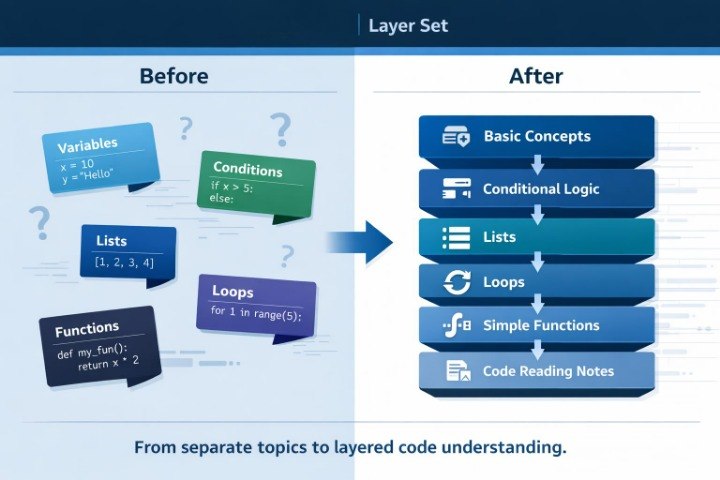
Layer Set offers learning materials where each topic is presented as a separate layer of understanding Python programming. First, the learner reviews basic concepts, then sees how they work in simple examples, and then moves to tasks with several steps. This format helps learners avoid jumping between topics and instead move in a steady order: concept, example, explanation, practice, and review. The tier focuses on connections between topics, so learners can see not only separate commands but also the wider structure of code. Layer Set works well as the next step after Free Set, when the learner wants more practice and deeper explanation.
What’s Inside
Layer Set includes an expanded collection of learning modules focused on the main layers of Python programming. The first module reviews basic concepts: variables, data types, text values, numbers, simple operations, and basic conditions. This is not just a short list of repeated terms. Each topic includes an explanation, an example, and a short learning note that shows why the topic matters for later tasks.
The second module focuses on conditional logic. Learners explore examples with if, else, and several types of checks. The materials explain how to read conditions, how to find the main check in a code block, and how to understand why the program follows one path instead of another. Each example includes a short breakdown: what is being checked, which value is being compared, what result is expected, and where mistakes may appear.
The third module is about lists and working with groups of values. Learners see how to store several elements in one structure, how to refer to individual elements, how to change values, and how to read simple examples with lists. The materials avoid overloading learners with complex structures and instead show gradually how lists can make code cleaner and more readable.
The fourth module introduces loops. This block explains why repeated actions are useful in code, how a basic loop works, how to read the result of each pass, and how to follow the order of execution. Learners receive examples where a loop works with a list, checks a value, or creates a simple result. After each example, there is a short explanation of what happened at each step.
The fifth module introduces simple functions. The materials explain why part of the code can be placed into a separate block, how a function name describes its action, how values are passed, and how a result is returned. In this tier, functions are presented at a basic level so learners can understand the idea of reusing code rather than simply copying syntax.
Layer Set also includes practical tasks after each module. They use different formats: complete an example, fix a mistake, explain a line of code, change a condition, add a new element to a list, or describe the result of execution. The tasks are not built around loud claims; they are focused on careful work with each topic.
A separate part of the tier is the “Code Reading Notes” block. Here, learners practice not only writing code but also reading it. This is an important stage because understanding a completed example often helps learners see the structure of their own work more clearly. The notes explain how to look at code from top to bottom, how to notice dependencies between lines, and how to check what changes after each action.
Layer Set also includes short summaries after every block. They help learners return to the topic without rereading the full module. The summaries include key ideas, common mistakes, and self-check questions. For example: “What changes if the condition is different?”, “Which value is stored in the variable?”, “How many times does the loop run?”, “What does the function return?”.
Who Is This For?
Layer Set is suitable for learners who already have an initial understanding of Python programming and want to organize the basic topics more clearly. It is a good option for those who completed Free Set or have already seen variables, conditions, lists, and simple functions, but want to study them more calmly and in more detail.
This tier also fits learners who often feel that separate concepts make sense, but they start to blend together inside a full example. Layer Set helps break the material into layers so learners can see how one topic leads to another. It is useful for those who prefer learning through examples, short tasks, mistake explanations, and review notes.
What You’ll Learn
- How to combine variables, conditions, lists, and functions in one example.
- How to read code in order and see the role of each line.
- How simple conditional logic works.
- How to create and change lists.
- How to use loops for repeated actions.
- How to understand the basic idea of functions.
- How to describe code execution in your own words.
- How to find common mistakes in simple examples.
- How to work with learning notes after each topic.
- How to prepare for wider Codaryn tiers.
30-Day Refund Policy
Layer Set includes a 30-day refund policy. If, after purchase, the learner sees that the format of the materials does not fit their needs, they can contact the Codaryn team within 30 days. The request is reviewed according to the terms described on the site. This policy is created for a calm introduction to paid Codaryn materials without extra pressure.
How is learning organized in Codaryn?
How is learning organized in Codaryn?
Learning is divided into topics, blocks, and practical examples. This format helps learners study Python programming through an organized path: concept, example, task, and review.
Can a paid order be refunded if the course does not fit my needs?
Can a paid order be refunded if the course does not fit my needs?
Yes, paid tiers include a 30-day refund policy. If the materials do not match the learner’s expectations, they can contact the Codaryn team within 30 days after purchase, and the request will be reviewed according to the refund terms.
What is included in Codaryn tiers?
What is included in Codaryn tiers?
Depending on the tier, learners receive learning modules, practical tasks, code examples, term explanations, short topic summaries, and additional resources for review. The tiers are arranged in a growing order, with each following tier offering a wider set of materials.
Are Codaryn courses suitable for starting Python programming?
Are Codaryn courses suitable for starting Python programming?
Yes, Codaryn materials are organized to help learners gradually explore Python programming topics. Each tier has its own depth, from introductory explanations to wider collections with tasks, examples, and learning resources.
Share